I’ll confess that when I first scanned the texts for this Advent season, year B, I felt puzzled that Mark 1:1-8 was assigned for the second Sunday. Where does this text fit in the movement of this season? It’s not (on its face at least) an apocalyptic text, so it doesn’t seem to continue the theme of the first Sunday of Advent. On the other hand, neither is it a text that leans into Christmas. Mark is, ironically, the only gospel that does not have a birth narrative for the Messiah – unless verse one is it! In Mark’s gospel, both of John and Jesus just arrive: John “appears” on the scene of the wilderness like a specter on the horizon; Jesus “comes” from Nazareth of Galilee to meet him by the Jordan. So, where does this text fit for the preacher and congregation who has one foot in Advent and another on the way to Christmas?
With a close reading, this short narrative is probably more apocalyptic than we realize. Though it bears few markers of classic apocalyptic, the gospel writer begins his story at the “turn of the ages.” John appears on the scene like the second-coming of Elijah, who is sent before the “great and terrible day of the Lord comes.” (Malachi 4:5; incidentally the last book of the Old Testament) He is dressed like Elijah and is located in the wilderness like Elijah, and recall that he is compared to Elijah by Jesus and his religious contemporaries. To use apocalyptic language, John arrives on the scene at the end of the old age and the dawning of the new. He is a figure from the past who announces one who is arriving from the future.
His location in the wilderness is significant because it places him, and those who go to meet him, in a liminal or threshold space. Unlike other gospels, who want us to know the geographic wilderness in which John was located or Jesus was tempted, Mark is uninterested in the precise location. He is more concerned with its metaphorical, theological, and spiritual significance. It is a wilderness like the wilderness in which the people of Israel wandered as they made their way from captivity to deliverance, tripping over their idolatries and learning to be the covenant people of God. It is a wilderness like the one in which Jesus is tempted by Satan, living with wild beasts, and ministered to by angels, before he announces himself and the arriving reign of God publicly. (Mark 1:12-13) It is a wilderness like the space in Isaiah 40 (the Old Testament reference to which Mark alludes), which is the space between the exile of Babylon and the homeland of Jerusalem, a space where the road for the Lord will be prepared, the space over which the exiles will travel home, a space of both difficulty and promise, of travail and anticipated triumph.
John appears in this wilderness, this threshold space and preaches repentance and calls the people to prepare the way for the Lord to arrive. “All the people” (surely a narrative hyperbole) go out from Judea and Jerusalem to meet John and be baptized by him in the wilderness. He does not go to them, they go to him. They relocate themselves in the metaphorical, theological, and spiritual wilderness in order to prepare for the Coming One. In the wilderness, John declares the promise that One is coming who is much more powerful than he. (Parenthetically, the degree of difference to which John points between himself and the Messiah can hardly be overstated. Untying a person’s sandals was one of the most menial tasks imaginable, which even a Hebrew slave-servant was exempt from doing. If John – the second coming of Elijah! – is unworthy of doing that, it not because he is so low, but because the One who is coming is so great.) And, to look ahead, when the Coming One arrives on the scene of this gospel, he goes immediately into the wilderness to prepare himself to inaugurate, with his life, a new age.
For the preacher, who is looking for an Advent doorway in this text, it may be helpful to think of three dimensions here: there is the location of wilderness, the preacher in the wilderness who points to the Messiah and calls us to repentance, and the promise of the wilderness that the Messiah is coming with the Holy Spirit. Any of those three dimensions could offer a way through the text and into Advent proclamation. We often visit the theme of wilderness on the first Sunday of Lent, but it is no less appropriate here in Advent. This, too, is also penitential season, a season of spiritual preparation, especially with John’s call to repentance. Repentance means changing the mind, or being transformed, or turning to face a new direction (or new age!). The preacher in the wilderness who points to the Messiah is a powerful image of the disciple or the church today, who points to the Messiah. Through our lives, both individually and collective, the church is both gifted and charged with John’s ministry: to meet people who find themselves in wilderness space and declare a word of hope in the Coming One; to announce that the old age is passing away and a new age is dawning; and to call, like John, for people to turn and face in this new direction.
And, of course, the promise of the Coming One, who arrives with the Spirit, is the great hope that courses through this text and this gospel. Going back to the first verse, Mark 1:1, the heading of this section of Mark, Jesus is the Son of God, the Messiah – meaning the Deliverer, the Rescuer, the Savior. The next time we hear that title applied to him without reservation in the gospel of Mark will be at the cross, when Jesus breaths his last and the curtain of the Temple is torn in two, and the centurion confesses that, “Truly, this man was God’s Son!” (Mark 15:39) The movement of the whole gospel of Mark, and indeed the movement of a life of Christian faith, is for us to join the centurion in making that confession, with an ever-deepening awareness of God’s work in Christ. This movement is not made once, but over and over, season by season, as we go back to Galilee and look for him again, with new concerns and new questions.
The journey begins, always, so Mark wants us to know, in the wilderness, with a preacher who is calling us to turn around and look for the Messiah who is coming to meet us.
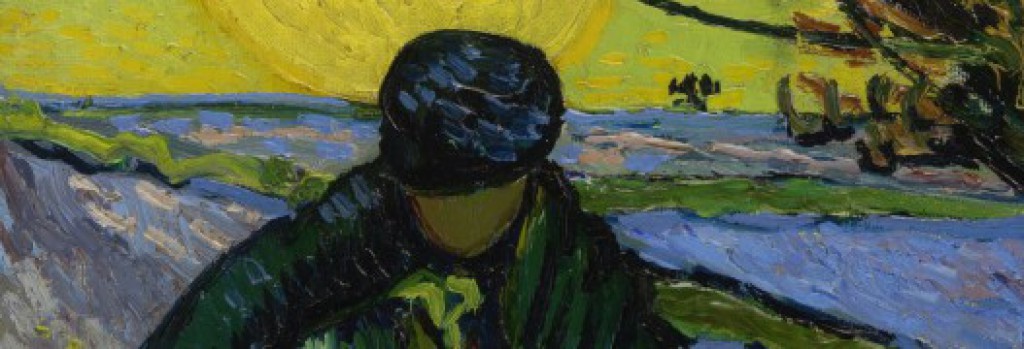
(Image: John the Baptist in the Wilderness of Judea by Dale Bargmann)
 Patrick W. T. Johnson