
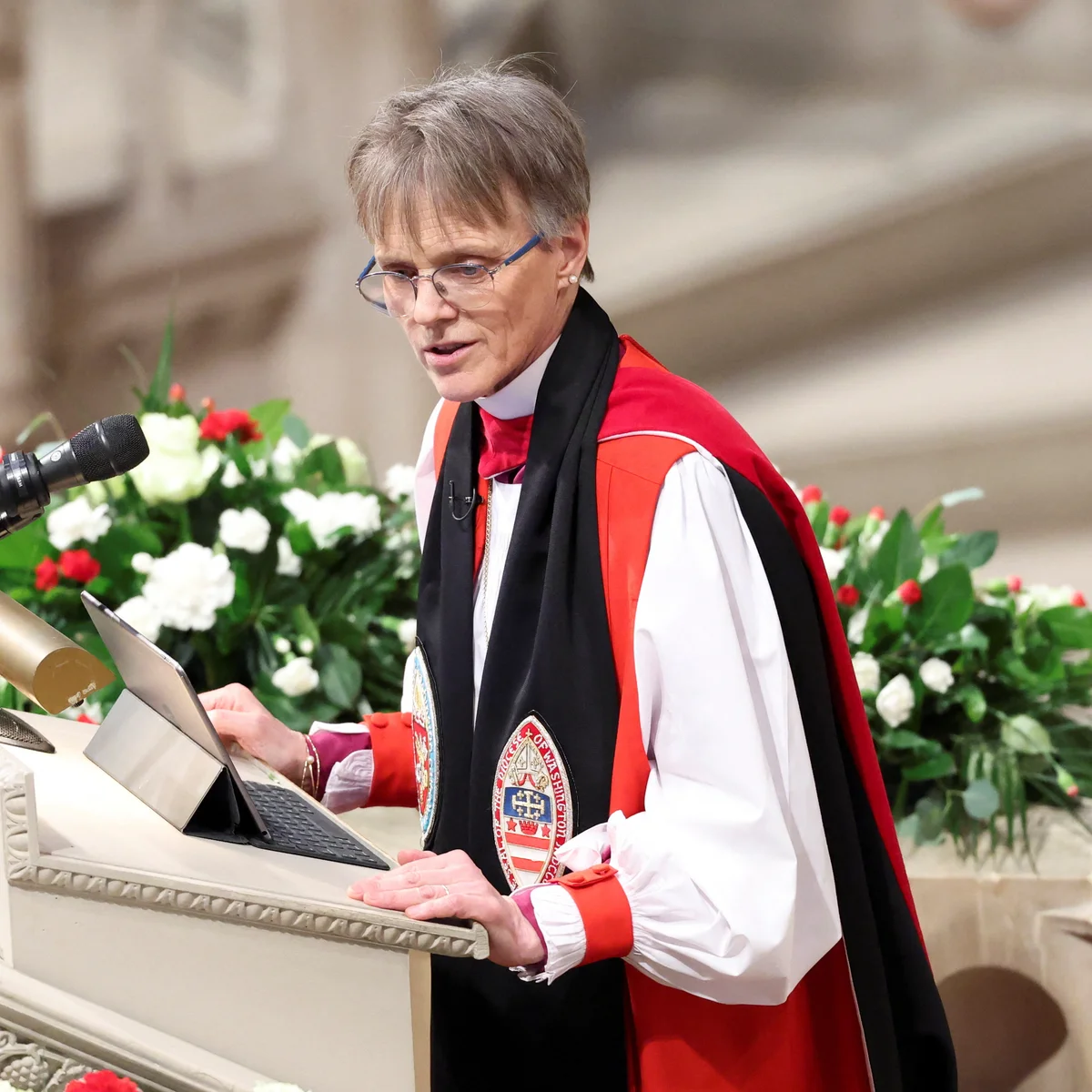
As you might imagine, it’s vanishingly rare that my academic training in the history of preaching feels at all relevant to the daily news. And then this week happened, when the Rt. Rev. Marian Edgar Budde preached to President Trump in the National Cathedral.
Her direct speech at the end of the sermon (that’s what a sermon is, by the way, direct address) annoyed the President, offended his supporters, and encouraged his detractors as it ricocheted around our political echo chamber. Contrary to many descriptions, I don’t believe she called him out. She spoke to him directly. She exhorted him to show mercy. In just that way, the Rt. Rev. Budde continued well in the ancient tradition of Christian court preaching.
Historically, we call these preachers “court preachers” because they preached to the royal court, and there are many examples in history. It’s unusual for an ordinary preacher to speak directly to one person in the congregation (that would be awkward!), but it’s not at all unusual in court preaching. The preacher addresses the Head of State, the person with the power to render justice and mercy.
The court preacher who came to mind immediately this week was a French priest named Jacques-Benigne Bossuet. Like Budde, he spoke in plain speech to the powerful person in the room. As a young priest, he was brought to the court of King Louis XIV to preach a cycle of sermons for Lent in 1662. Louis’ mother, Anne, was concerned that the libertine court would lead her young son astray and she hoped that Bossuet could buttress his moral foundations.
Bossuet’s twelve surviving sermons, the Careme du Louvre, represent one of our finest examples of classic Christian oratory. He preached with conviction and passion and directness. He did not flatter the king, nor did he pull his punches when criticizing the king’s court. His words on Good Friday are an ancient echo of Budde’s call for mercy: “Sire, let not your Majesty tire: as suffering mounts, so mercy must be extended . . . it is the dying Jesus who exhorts you, Sire; he commends to you your poor.”
In the short run, Bossuet’s words had little effect. The libertines were quickly ascendent. In the long run, he returned to the royal court and was instrumental in Louis XIV’s conversion to the active Christian faith which marked his later life.
Like Bossuet (and countless others across the centuries), the Rt. Rev. Budde articulated the implications of the Gospel respectfully, clearly, and directly to the person in power. This is what good and faithful preachers have always done when the court comes to church.
You can read much more about Bossuet here: https://crisismagazine.com/opinion/jacques-benigne-bossuets-careme-du-louvre-at-350.
And… a bonus fascinating story about the preacher who spoke the truth with clarity and love to Richard Nixon about Watergate is here: https://www.christianitytoday.com/2024/07/richard-nixon-watergate-minister-huffman-spoke-love/
 Patrick W. T. Johnson